
This is where physiotherapy and rehabilitation in Hyderabad plays a role that is far more significant than most people realise.
Rehabilitation is not a bonus step you add after recovery. It is recovery. Structured, medically supervised, and deeply personal. Without it, many patients plateau, lose ground, or face complications that could have been avoided entirely.
Why Recovery Does Not Happen on Its Own
The human body is resilient, but it is not self-correcting after serious illness or surgery without the right support.
When a patient spends days or weeks in a hospital bed, several things happen simultaneously. Muscles begin to weaken from disuse, and research shows that patients can lose up to 5 percent of their muscle mass per day during prolonged immobility. Joints stiffen. Lung capacity reduces. The nervous system's ability to coordinate movement becomes sluggish. Appetite drops, which slows tissue repair. And the emotional weight of illness adds its own layer of difficulty on top of everything physical.
Rest alone does not undo these effects. In fact, prolonged rest without structured rehabilitation often makes them worse.
This is why rehabilitation therapy in Hyderabad has become an essential part of post-hospital care for patients recovering from stroke, surgery, neurological conditions, cardiac events, and critical illness. The longer rehabilitation is delayed, the more ground the patient loses and the longer the road back becomes.

What Physiotherapy and Rehabilitation Actually Involves
Many families use the words physiotherapy and rehabilitation interchangeably, but they are not the same thing.
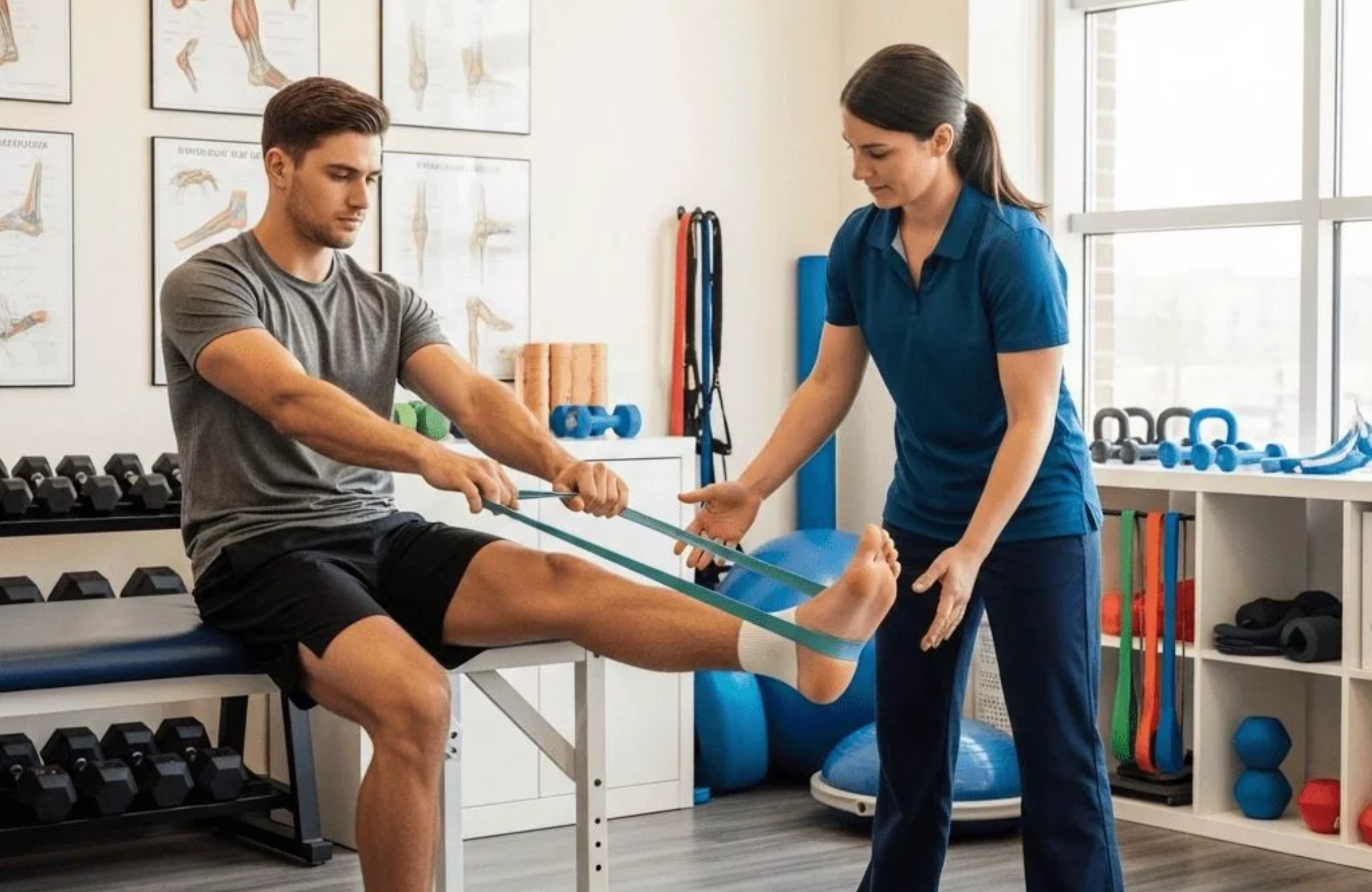
Physiotherapy is one component within rehabilitation. It focuses specifically on restoring physical movement, strength, and function through targeted exercises, manual therapy, and guided activity.
Full rehabilitation is a coordinated programme that addresses everything affecting a patient's recovery, not just the physical.
At a quality rehabilitation centre in Hyderabad, the care team typically includes:
- Physiotherapists who work on mobility restoration, gait training, muscle strengthening, and balance improvement.
- Occupational therapists who help patients relearn daily tasks like dressing, bathing, eating, and navigating their home environment safely.
- Speech and language therapists who address swallowing difficulties and communication challenges, which are common after stroke or neurological events.
- Dietitians and nutritionists who ensure the body has what it needs for strength rebuilding and tissue repair.
- Mental health professionals who support patients through the emotional side of recovery, including anxiety, depression, and loss of confidence.
- Nursing staff who monitor vital signs, manage medications, prevent complications, and ensure patient safety around the clock.
This is what multidisciplinary rehabilitation looks like in practice. And research consistently shows it produces significantly better recovery outcomes than physiotherapy alone.
When Should Rehabilitation Begin After Hospitalisation?
This is one of the most common questions families ask, and the answer matters enormously.
The general clinical consensus is that rehabilitation should begin as early as medically appropriate, sometimes even within the hospital itself, before the patient is discharged.
For stroke patients, rehabilitation often begins within 24 to 48 hours of the event. For post-surgical patients, it may start within the first day or two after the procedure, depending on the surgery type and the patient's condition. For post ICU rehabilitation in Hyderabad, timing depends on the patient's stability, but the principle remains the same: early intervention leads to better outcomes.
Delays in starting rehabilitation have real consequences. Muscles that are not used begin to atrophy rapidly, particularly in elderly patients and those who have been critically ill. Joints stiffen. The nervous system loses practice in movement patterns it needs to relearn. Every week of delay makes the recovery journey longer and harder.
Families are often told to "wait and see" or to "just rest for a while" before starting any rehabilitation. In many cases, this advice unintentionally allows preventable decline to set in. If your loved one has been discharged from hospital and is still not fully functional in movement, strength, or daily activity, the time to begin structured rehabilitation is now, not later.
Conditions That Require Rehabilitation Support
Physiotherapy and rehabilitation for faster recovery is relevant across a wide range of medical conditions.
Stroke and neurological events: are among the most common reasons patients need structured rehabilitation. The damage to movement, speech, and coordination requires expert, consistent intervention to rebuild function that the brain can no longer manage automatically.
Post-surgical recovery: including orthopaedic surgeries like hip and knee replacements, spinal procedures, cardiac surgeries, and major abdominal operations, places enormous stress on the body. Without structured rehabilitation after surgery, complications including muscle atrophy, joint stiffness, and reduced lung capacity are significantly more likely.
Neurological conditions: such as Parkinson's disease, Guillain-Barre syndrome, multiple sclerosis, and traumatic brain injury require long-term, carefully supervised rehabilitation programmes that adapt as the patient's condition evolves over time.
Rehabilitation after a prolonged hospital stay or ICU admission: is necessary because the body deconditions across multiple systems simultaneously, not just in the area of the original illness. Physical rehabilitation services must address all of these systems together, not one at a time.
Cardiac and pulmonary conditions: leave patients significantly weakened throughout the entire body and require monitored physical rehabilitation under continuous medical supervision. Elderly patients recovering from falls, fractures, or serious illness are among the most vulnerable to rapid functional decline, and they require the most carefully calibrated rehabilitation support.
In each of these cases, coordinated rehabilitation delivered within a structured, clinically supervised environment gives patients the best available chance of returning to meaningful independence.
What Inpatient Rehabilitation Offers That Home Care Cannot
There is a significant difference between inpatient rehabilitation in Hyderabad and receiving occasional physiotherapy visits at home.
Inpatient rehabilitation means the patient is based at the rehabilitation centre for the duration of their programme. This allows for daily, structured therapy sessions across multiple disciplines rather than one or two visits per week.
It also means continuous nursing supervision, which is critical for patients who are still medically complex. There is immediate clinical response if a complication arises, whether a fall, a change in blood pressure, or a medication interaction. The environment is specifically designed to support recovery, including the equipment, space, and professional presence that a home simply cannot replicate.
Perhaps most importantly, inpatient rehabilitation gives the full team, physiotherapists, occupational therapists, speech therapists, dietitians, and nursing staff, the ability to coordinate care in one place and adjust the programme together based on daily progress.
For patients who are still fragile, managing multiple conditions, or who have not yet regained safe functional independence, inpatient rehabilitation is not a luxury. It is the clinically appropriate level of care.
What Patient-Centered Care Looks Like in Practice
Recovery rehabilitation programs that work are not built around generic protocols. They are built around the individual.
In practice, patient-centered care in rehabilitation means the treatment plan is reviewed daily based on how the patient is actually responding, not on a fixed schedule. If a patient is fatigued, the session is adjusted. If they are progressing faster than anticipated, the programme advances. If their pain levels change, the clinical team reassesses before continuing.
It also means the patient and family are kept informed at every stage. Families receive clear updates on what is being worked on, why, and what to expect next. They are not left to guess or to find information secondhand.
And it means the patient's dignity, comfort, and emotional state are treated as clinical priorities, not afterthoughts. Patients who feel safe, seen, and genuinely supported do not just feel better emotionally. The evidence consistently shows they recover faster, more completely, and with fewer complications.
How Long Does Physiotherapy Rehabilitation Take?
There is no single answer to this, and any centre that gives you a fixed timeline without assessing the patient individually should be approached with caution.
Recovery timelines depend on the condition being treated, the severity of the patient's presentation, their age and overall health, how soon rehabilitation began after the acute event, and how consistently the programme is followed.
Some patients make significant progress within four to six weeks. Others with complex neurological conditions or those recovering from prolonged ICU stays may require several months of structured, coordinated rehabilitation.
What matters is not the speed of recovery, but the quality of it. A patient who regains genuine, safe functional independence after three months of properly supervised rehabilitation is in a far better position than one who was rushed through a shorter programme and returned home still dependent on others for basic daily tasks.
Frequently Asked Questions
How does rehabilitation help recovery?
It rebuilds what illness takes away. Structured rehabilitation restores strength, movement, and function in ways that rest alone cannot.
When should rehabilitation begin after hospitalisation?
As soon as the patient is medically stable. In most cases, that means within the first few days after discharge, or even earlier.
How long does physiotherapy rehabilitation take?
It depends on the condition and the patient. Some see meaningful progress in four to six weeks. Others with complex conditions need several months.
What conditions require rehabilitation support?
Stroke, neurological conditions, post-surgical recovery, post ICU care, cardiac conditions, orthopaedic injuries, and serious illness in elderly patients all commonly require structured rehabilitation.
Taking the Next Step
If someone you care for is in the gap between hospital discharge and full recovery, the most important thing you can do right now is understand that this gap can be bridged with the right support.
Physiotherapy and rehabilitation in Hyderabad, when delivered within a medically supervised, multidisciplinary environment, gives patients the best available chance of returning to meaningful, independent daily life.
If you would like to understand what the right rehabilitation programme looks like for your family member's specific situation, the team at Care Convoy is here to help you think it through.
Speak With Our Care Team Today